
Tottenham Hotfurs
A Manifesto on Fashion, Morality and the Performance of Sustainability

For a designer in the age of climate crisis, the question is: can fashion be created without adding more product? With more garments in circulation than ever, the task is no longer simply to invent, but to confront and transform the excess that already exists.
Fur coats are a telling example. So many people still have them tucked away in attics, inherited from grandmothers, stored with care, never discarded because of their emotional value. They are good coats, made to last, but trapped in a taboo: too uncomfortable to wear, too precious to throw away.
In the language of contemporary fashion, “fur-free” has become a shorthand for ethics. With a growing demand for sustainable and cruelty-free products, fake furs have developed into an acceptable and “environmentally friendly” alternative to real fur. Since the 1980s, campaigns led by PETA and others have so thoroughly vilified real fur that it now lingers as a cultural taboo. And yet, on the runway and in fashion imagery, fur remains omnipresent, its visual codes recycled in shows, editorials, and campaigns. The allure of fur as a symbol of luxury and status persists, even if its material reality has been replaced. Faux fur neatly fills this gap: it offers the look without the guilt, allowing brands to maintain the aesthetic while corporate sustainability pages reassure us with promises of “fur-free,” “sustainable,” and “cruelty-free” alternatives. Beneath this performance, however, faux fur is no less implicated in environmental violence.
Yet the question is not just about fur versus faux fur. The deeper issue is the material reality of synthetic fibres, the fossil-fuel backbone of fashion’s supposedly “sustainable” alternatives. Marketed as cruelty-free, they continue to feed the industry’s dependency on oil, all while disguising its deeper dependency: the imperative of perpetual consumption.
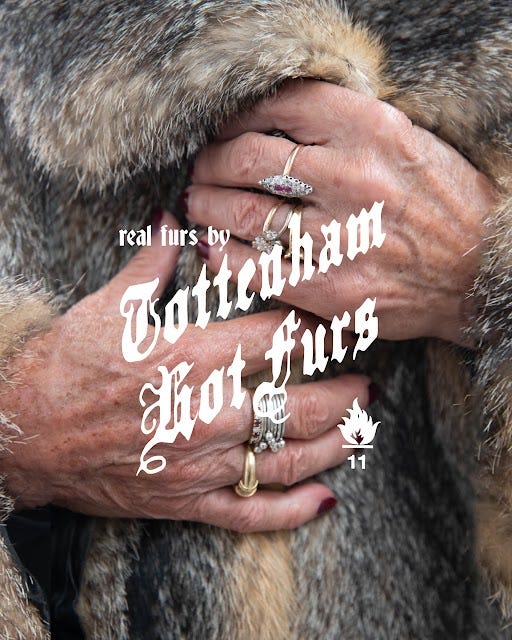
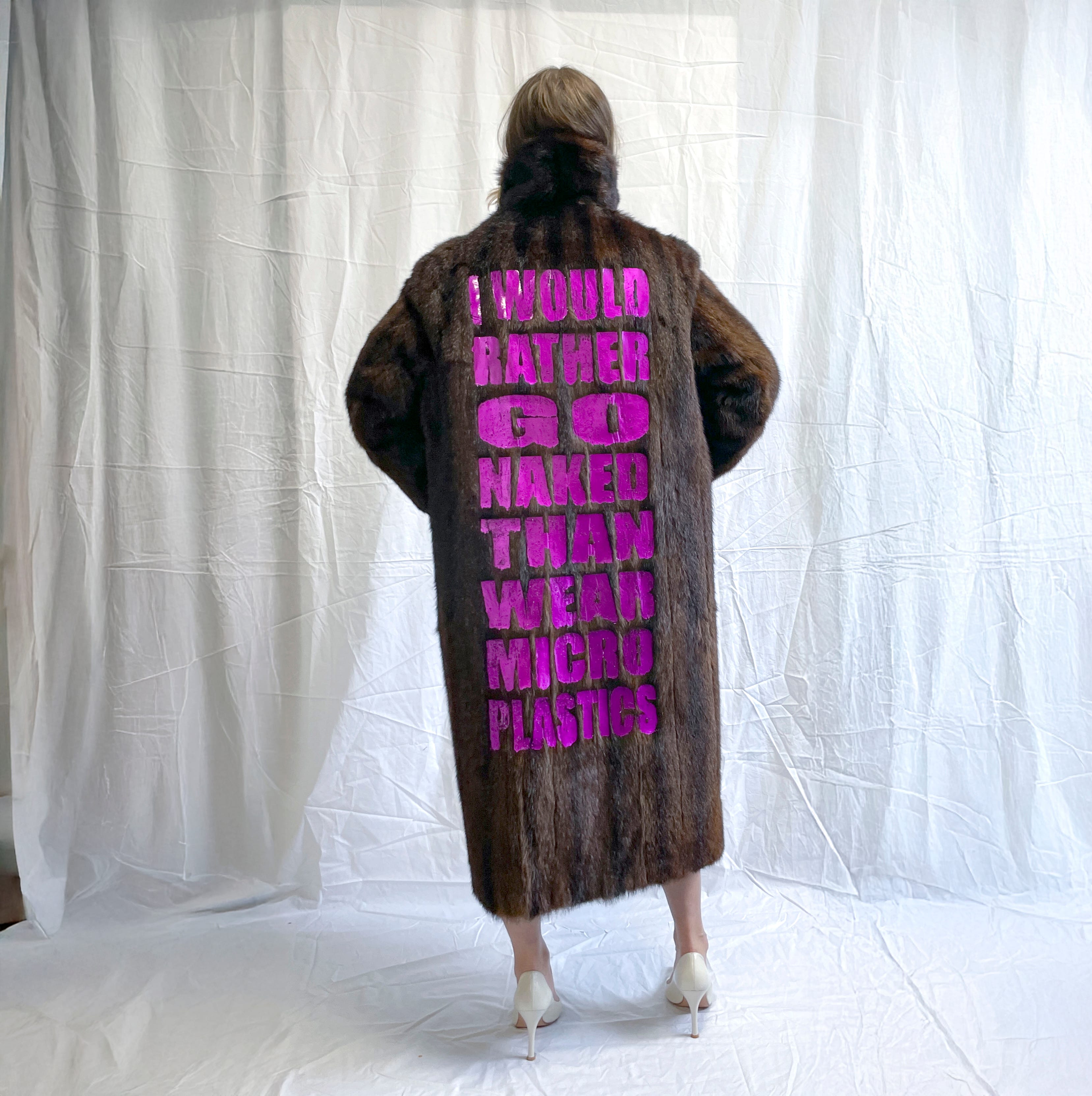
Tottenham HotFurs is a project about the interrogation of fashion, ethics, and cultural contradiction. By upcycling and reworking vintage real fur, we designed and developed a team of eleven coats, each representing a fictional player on a football team. Together, the team embodies contradiction, forcing confrontation with widely accepted ideas of sustainability, consumption, and morality in fashion. The project interrogates greenwashing practices in faux fur and probes the environmental and ethical dimensions of reusing existing materials, asking what is the true meaning of sustainability. The aim is not to make fur palatable, but to embrace the controversy and discussion, confronting what sustainability has become: a performance that substitutes symbols for substance.
Sustainability™
Sustainability has been hijacked by marketing. It doesn’t slow consumption; it gives us permission to buy more. Once, the word implied responsibility, foresight, and the acknowledgment of consequence. Today, it has been co-opted by brands, repurposed as a story that comforts the buyer while leaving the structural issue of overproduction untouched. Those who care most, conscientious shoppers, independent designers, and activists, are hit hardest, as their values are mined for profit and translated into marketing content. The promise is seductive: that buying more can also mean doing good. Yet this logic is circular in every sense except the ecological one.
What is sold as sustainability is often a product in itself. Certifications, labels, and reporting frameworks demand significant investment, specialist knowledge, and bureaucratic capacity, making them accessible almost exclusively to large corporations. Meanwhile, accreditations circulate without verification, sold to the highest bidder, creating a marketplace where ethics function as performance rather than as practices of reflection, restraint, or accountability. Responsibility is displaced onto individual consumers to make the “right” choice, while structural change lags behind, producing cynicism and fatigue.
The paradox is clear: the very systems designed to signal responsibility actually reinforce inequality.
True sustainability is messy, uncomfortable, and contradictory. It asks us to reckon with consequence, resist novelty and obsolescence, and interrogate the systems that structure our lives. Yet the way it is sold plays upon our personal morals and values and directs us inward, toward guilt, indulgence, or restraint, while leaving untouched the frameworks that profit from defining morality in the first place.
So the question is not whether we are making the “right” choices. The question is: who decides what “right” means, and who benefits from the story?
Capitalism / Design for Obsolescence
At its core, capitalism is defined by growth. It organises life around acceleration, turnover, and the continual expansion of production and consumption.
This logic shapes the objects around us. Nowadays products are rarely made to endure, they are made to circulate. A product that lasts ten years slows the market, while one designed for replacement every two years sustains it. The planned obsolescence of these items is deliberate, using mechanical failures, fleeting visual trends, or technological updates to ensure the cycle of need/desire continues.
Capitalism doesn’t just affect products, but also attention, habits, and expectations. Launches, drops, and seasons have begun to dictate rhythms of desire, encouraging a system where performance is measured in speed, visibility, and novelty rather than longevity or craftsmanship.
The outcome is a culture of perpetual dissatisfaction where each act of consumption points toward the next one and transience becomes the condition of worth. To consume is not to be fulfilled, but to remain in motion.
Who benefits? Not the consumer, nor the designer, whose craft is subordinated to churn. The winners are those who profit from circulation itself: capital, finance, and shareholders. These are the institutions who extract value from instability and constant growth.
Speed and scale is the foundation on which all subsequent stories (of sustainability, ethics and progress) are built. Before they become narratives, they are necessities of a system that must keep moving, even if what it produces is designed to fall apart.
The Death of Nuance
Social media has trained us to flatten complexity. Ideas that don’t fit into a headline or a reel are lost within the swell of the algorithm. In order to be ‘shareable’, a thought must become a slogan. Complex ideas are reduced into short quips that function only if they can be understood in the 3 seconds it takes to scroll to the next image.
This logic doesn’t just live online, it seeps into how culture is structured. The line between dialogue and branding has blurred to the point where we are no longer sure if we are interacting with humans or advertising campaigns. Instead of knowledge, we get brand narratives, carefully positioned in order to offend no one and reach everyone. What matters is not whether something is true, but whether it feels right, or can be packaged neatly enough to spread.
But nuance rarely sells, and so we are left with branding, a language that thrives on clarity, even at the expense of truth.
Brands operate at the intersection of culture and capital. They convert aesthetics, ethics, and identity into market power. They assign value to consumption choices, teaching us who to admire, who to critique, and what counts as moral or tasteful. In this way, they do not merely reflect culture, they produce it. But the question lingers: when brands appear to advance culture, are they truly creating meaning, or are they harnessing culture to sustain the system of capital?
Fashion is a clear example of how this logic plays out. Complex questions of material use, labour, and overproduction are simplified into marketable labels: “conscious,” “eco,” “vegan.” Activists and consumers alike are forced into choosing sides: vintage real fur or faux fur, Adidas or Primark, luxury or fast fashion. As if these binaries resolved the contradictions of a global system built on overconsumption and disposability.
The problem is not that people lack the capacity to understand nuance, but that the system rewards simplification. When the dominant language of culture is branding, it becomes nearly impossible to hold space for trade-offs or contradictions. Animal rights activists are positioned against environmentalists, even when both ultimately push back against extractive systems. Vintage fur is vilified while polyester is praised, as if the problem could be solved by picking a side. Brands depend on these simplified binaries because they make consumption feel political, even when the underlying issues are left untouched.
And so activism is not only diluted, it is co-opted. However the fact remains that true sustainability resists simplification. It cannot be reduced to a tagline or condensed into a trend report. If it can be communicated in a single slogan, it is almost certainly not the full story. But nuance rarely sells, and so we are left with branding, a language that thrives on clarity, even at the expense of truth.
The Current State of Fashion
Fashion today is defined by acceleration and excess. Cycles have collapsed from seasons to weeks, collections to drops and garments to swipeable content. Clothing is less about dressing bodies than about feeding an endless circulation of images. The churn is celebrated as progress, democratization, accessibility and endless choice, but it comes at enormous material cost.
What often gets framed as a “waste” problem begins much earlier, at the level of fibers. In 2023, the industry produced over 120 million tonnes of textiles, more than 70% of them synthetics derived from crude oil. Polyester alone dominates production, locking fashion into fossil fuel dependency even as the climate crisis accelerates. At current trajectories, fibre production is expected to rise another 60% by 2030, pushing the industry well beyond the emissions limits outlined in the UN Fashion Charter.
The problems embedded in synthetics are multiple. Their production is fossil-fuel intensive and carbon heavy; and even during their lifespan every wash creates microplastics that now make up an estimated 35% of ocean plastic pollution. Many fabrics contain toxic “forever chemicals,” contaminating ecosystems and human health. Blended textiles (for example cotton mixed with polyester or wool mixed with nylon) make recycling nearly impossible, ensuring that most garments will end their lives in landfill or incineration. The recycling that is celebrated in marketing rarely involves clothing at all: most “recycled polyester” is made from plastic bottles, not old textiles, diverting material away from closed-loop systems and into garments destined for disposal.
The system thus generates waste by design. More than 92 million tonnes of clothing are discarded annually, much of it exported to the Global South where it floods markets, clogs landfills, and pollutes waterways. The “green” promise of synthetics is further muddied by the rise of petroleum-based fabrics branded as vegan; a sleight of hand that frames plastic as ethical simply because it does not involve animals, while ignoring its devastating environmental impact.
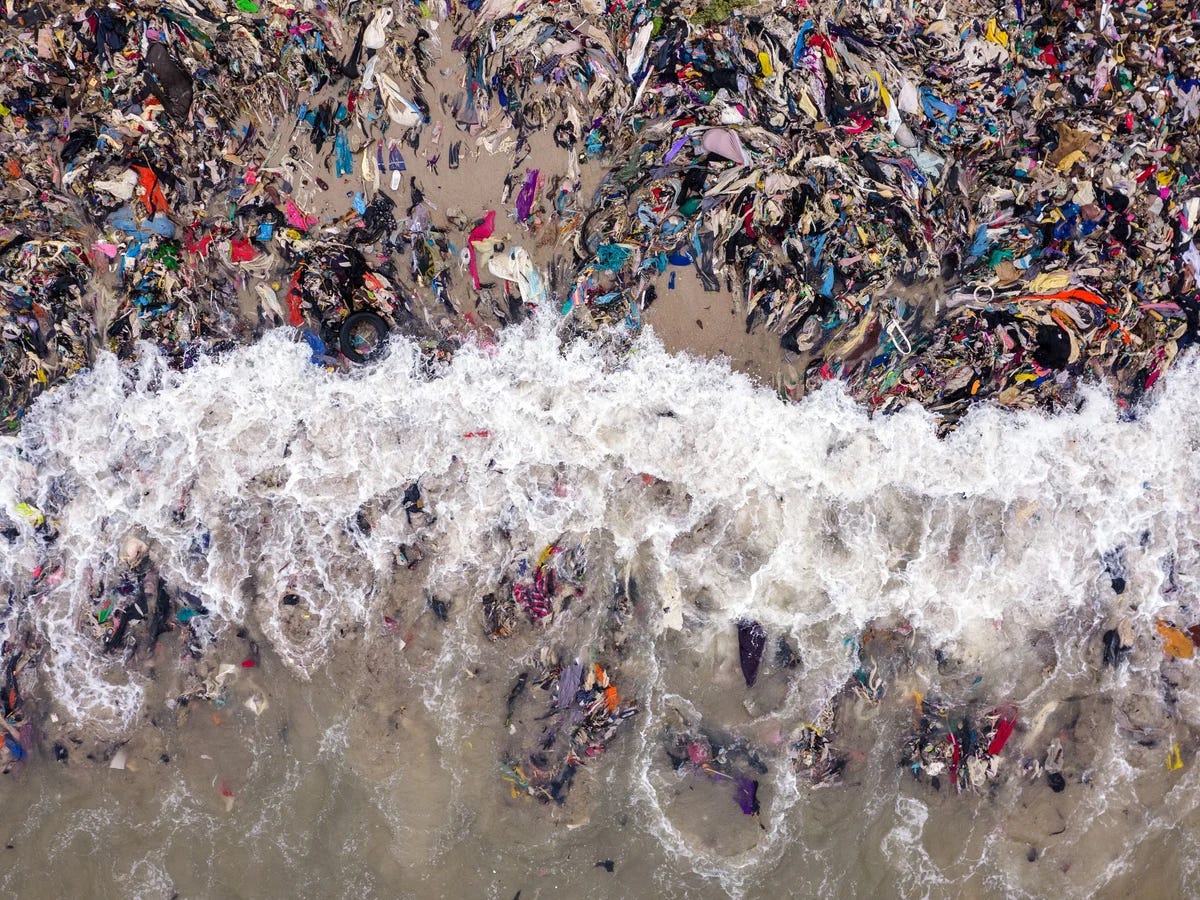
Photo: Discarded fashion waste washed up the cost from Jamestown in Accra, Ghana. Photo: Muntaka Chasant
Meanwhile, the garments themselves are less durable than ever. Fabrics are thinner, stitching is weaker, and designs are less enduring than in previous generations. Fashion has ceased to produce clothing built to last, it produces obsolescence, where turnover is the only value.
Big Oil /
‘Shell is a Fine Company, if I’m to Believe Their Website’
Behind every polyester hoodie or nylon dress lies a refinery. Polyester, nylon, acrylic, spandex; these are not just textiles but plastics, spun from oil and gas. Their origins are in ethylene and paraxylene from crude oil, the same feedstocks that fuel cars and power plants. Fashion is often framed in terms of waste or overproduction, but at its core the industry is increasingly an extension of the fossil fuel economy.
This is not incidental. For decades, oil companies have faced an oversupply problem: too much refining capacity and the prospect of shrinking fuel demand as renewables, electric vehicles, and climate policy advance. Petrochemicals (plastics, fertilisers, synthetic fibres) offer a lifeline. Already 14-15% of global oil use, they are projected to drive nearly half of demand growth by 2050. Fashion, with its appetite for cheap fibres and reliance on blends, is central to that shift.
The supply chain reflects this integration, as major fibre producers like Indorama, Reliance, and Sinopec are subsidiaries or affiliates of oil giants. The same firms extracting crude oil also manufacture the polymers that become polyester and nylon. By pushing synthetics, “Big Oil” keeps refineries profitable while embedding itself in fashion’s global supply chains.
Clothing offers distinct advantages, as unlike fuel, synthetics persist; woven into wardrobes, resale markets, and trade flows. This creates durable dependency, reinforced by marketing that frames polyester as “recyclable,” “vegan,” or “low water” compared with cotton. Recycling schemes, often bankrolled by petrochemical firms, sustain oil’s legitimacy more than they solve waste.
The rebranding power is striking. Petroleum-based fibres are now sold as sustainable, like “recycled” polyester from bottles, “vegan” leather from polyurethane. These narratives soothe consumer conscience while obscuring the reality: fashion is becoming one of Big Oil’s strongest growth engines.
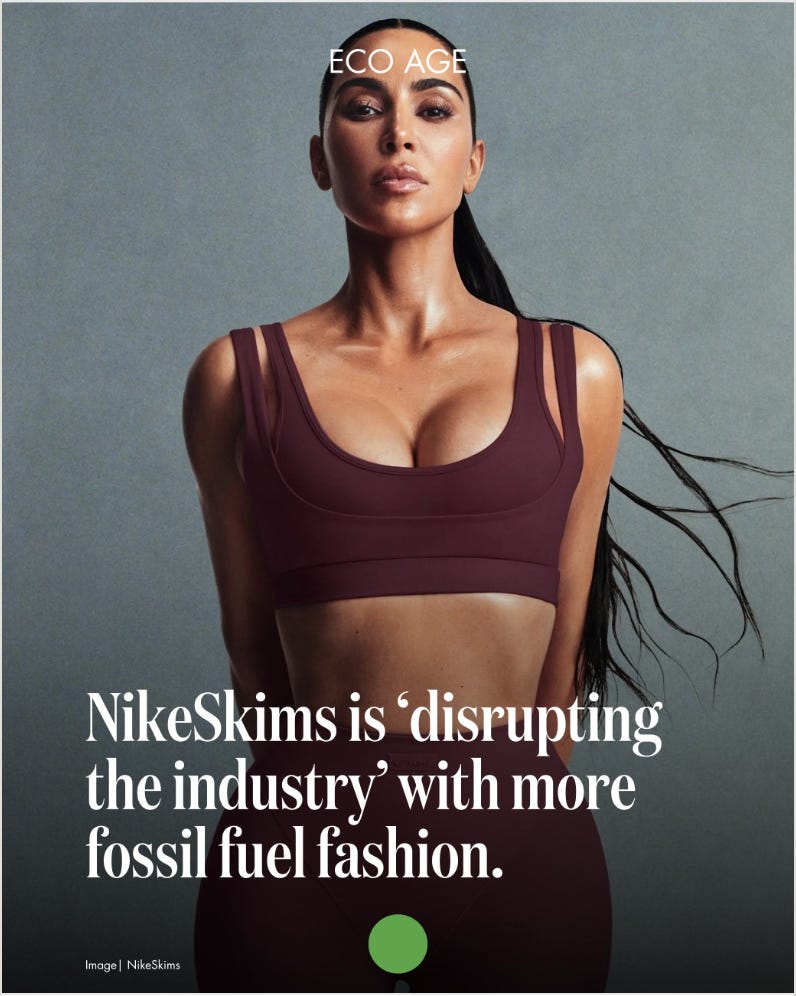
Photo: Eco-Age Linkedin Post on Fossil Fuel Fashion
This strategy is explicit. ExxonMobil, Shell, Aramco, and Sinopec all describe petrochemicals as core to their future. Aramco invests in polyester recycling; Reliance, a polyester giant, markets itself as a sustainability leader. Trade groups tied to petrochemical firms are active in “circular fashion” debates. The pivot is deliberate, and it is succeeding.
Thus oil’s expansion into fashion is sold not as a liability but as a climate solution. Petrochemical companies fund textile recycling research, sponsor certifications, and partner with brands on “circular” initiatives. The very firms driving fibre growth now position themselves as arbiters of sustainability.
Fast fashion becomes a Trojan horse: normalising petrochemicals in daily life, embedding them in closets, and disguising oil dependency as creativity. A faux fur coat may signal compassion, yet it is spun from the same feedstocks as single-use plastics.
On Fur / I’d Rather Go Naked
The fur industry exists in a paradoxical space: highly scrutinised in public discourse, yet quietly resilient in private commerce. Activism from the 1980s onward, led by PETA and other animal rights organisations, encouraged major luxury brands like Gucci, Prada, Burberry and Chanel to adopt fur-free policies. These moves are (or were) often framed as ethical milestones, signalling progress to consumers. Yet behind the headlines, fur continues to circulate, particularly within private markets and heritage luxury houses.
Production remains geographically concentrated. Denmark, Finland, and Russia historically led mink and fox farming, while China has emerged as a major supplier in recent decades. On these farms, animals are raised specifically for their pelts. After harvesting, skins undergo chemical tanning with chromium salts, formaldehyde, and other preservatives to prevent decay, producing substantial wastewater and toxic byproducts.
Within Europe, however, the figure of the artisanal furrier was for centuries central to the trade. Family-run ateliers graded, dyed, and tailored pelts into bespoke garments, blending mechanised processing for efficiency with hand-sewn techniques for fit and finish. A single coat could take months of work, its price justified by durability: thirty to fifty years of wear, restyling, or repair. Offcuts were rarely wasted; they were stitched into cuffs, collars, muffs, or pieced together into “cut-down” jackets, cheaper coats that were made entirely from scraps. This ethic of resourcefulness and longevity, born from necessity, strangely echoes today’s calls for circular fashion or “responsible” manufacturing. Though only a handful of such ateliers remain, their model offers a striking counterpoint to the speed and disposability of modern fashion.
These handmade coats also carried emotional and cultural weight. Many consumers, even today, hesitate to wear them or discard them because of the taboo around fur.Their warmth, craftsmanship, and the labour embodied in them make them difficult to treat as waste. Instead, they linger in closets or attics, suspended in a kind of ethical limbo; too valuable to throw away, yet too controversial to wear. A grandmother’s coat passed down through generations connects wearers to family history and identity in a way fast fashion rarely achieves.
Mass-produced furs, by contrast, tend not to acquire the same resonance. Industrial tanning and standardised assembly prioritise speed and cost, producing garments that are visually striking but less likely to last decades or be altered and repaired with ease. Without the story of a furrier’s handwork, they function more as commodities than as heirlooms.
The industry today reflects these layered contradictions. Even as major brands publicly signal fur-free commitments, private sales and niche luxury collections sustain real fur commerce. LVMH exemplifies this duality: some brands within the group, like Celine, quietly avoid fur, while others, like Fendi, Dior, and Louis Vuitton continue to produce it. This dual approach allows the group to benefit from reputational capital on one side while sustaining profitability on the other. In practice, fur exists in a suspended state, denounced in public campaigns, preserved in private wardrobes, and continually rebranded within luxury markets.
Animal Rights / The Animal in the Room
Fur is easy to condemn. The body, the pelt, the death; it is unavoidably symbolic. Fur confronts us with the reality that an animal died to make this garment. It’s difficult not to be affected by such a powerful, beautiful, sad, impressive material. Plastic, by contrast, feels abstract. Faux fur alternatives in polyester and acrylic can be branded as “conscious,” while their costs remain hidden in pipelines, and invisible fibres in the ocean. Plastic is not necessarily a better choice, but it is a more marketable one.
What PETA has done to raise awareness about the mistreatment and abuse of animals in a huge global industry is admirable. PETA is not our adversary, nor are we interested in being positioned as their opposition. The fashion industry thrives on these binaries: cruelty-free vs. cruel, natural vs. synthetic, vegan vs. carnivore. The truth is messier. We stand against animal abuse and torture, and would be sceptical and reluctant to support a resurgence of the fur industry, knowing the dark details of some of these industry practices. But we are in favour of using what already exists. If we argue that fashion must work with what has already been produced, then turning our nose up at existing fur is simply another form of denial.
To keep vintage fur in circulation is to be reminded that fashion has a past, that objects endure, that choices endure. If the coat remains, then so does the animal. It is easy to dispose of it, to donate it away, to bury it in someone else’s landfill, but it can be more valuable to live with the confrontation. Perhaps the discomfort of fur is exactly what is missing. To wear something that carries consequences is to carry the weight of contradiction. Acknowledging the true cost of a garment, it is harder to treat clothing as disposable when it feels, literally, like something has been lost. As with meat, many of us would refuse to consume it if we witnessed the process of its making, or had to hunt, farm or kill the animals ourselves. As with waste, we accept it only because we never see where it goes. The less visible the consequence, the more comfortable the consumption.
Working on this project confronted us with these contradictions directly. Handling fur is not neutral; it is impossible to forget the animal it once belonged to. For one of us, a vegetarian, the experience was especially difficult. The closeness between skin and clothing, life and death, made the abstraction of “material” collapse.
What Fashion Means to Us / Post-Brand
Brands are dead. Once, a brand was a vision, a point of view, a community, a cultural anchor within a subculture. Today, many founders or designers think like entrepreneurs, focused on scaling, growth, and market opportunity rather than cultivating identity or dialogue. Subcultural beacons have been absorbed into corporate structures, and small independent labels increasingly mimic them, prioritising revenue and clients over culture or critique. Marketing dictates what is made, how it is presented, and how it is sold, leaving little space for experimentation or risk. The result is a proliferation of well-made, visually appealing products that lack critical context or meaningful voice. Celebrity and influencer-led brands illustrate this trend: prior fashion knowledge is often unnecessary, as market appeal and virality replace design lineage, and success is measured by reach rather than creative or cultural contribution.
Fashion has been absorbed by capitalism. Collections are built by precedent, endlessly recycling familiar archetypes into slightly new garments, while compressed design cycles leave little room for conceptual or experimental work.
The consequence is fashion that is rapid, disposable, and predictable; dependent on novelty, extractive materials, and fossil-fuel-intensive fibres. Its promise of innovation is undermined by relentless demands for growth and speed. Clothing is more abundant than ever, yet true fashion becomes increasingly scarce. Fashion education reinforces this cycle, training students to become the next generation of star designers for the runway, focused on curating existing universes rather than creating for the future. This method produces technically skilled hybrids of past styles, but leaves conceptual innovation largely abandoned. Designers are working with clothes, not ideas, often declaring “newness” a thing of the past. Without conceptual ambition, the hunger for profit dominates, and the world loses the idea of fashion itself.
Fashion, at its best, is more than clothing. It is a language for independent voices, a mirror of society, and a tool for thought. It can articulate the zeitgeist, challenge norms, provoke reflection, raise awareness of cultural, social, and environmental issues and help to express one’s individual identity and creativity. It can experiment, critique, and translate complex ideas into forms we can see, wear, and inhabit. In this sense, fashion is distinct from mere clothing: it carries meaning, conveys a message, and functions as a site of communication and reflection.
Living in the post-brand era, Parasite builds on the notion that brands are dead, and that only by detaching from the singular aim of finding clients can one define a unique creative vision. Parasite is not a brand, but an ongoing evolving project, an organisation with a more elusive state in the world, refusing the expectations normally associated with brands.
From the flesh of the earth
Embracing the nihilism of the current landscape, Parasite leeches on the existing ecosystem of products, materials, and commercial systems, holding up a mirror to society through design. It uses the world around it to (re)create, from materials and products to digital content and news. By refusing to identify as a brand, Parasite bridges the gap between art and design, exploring their intersections and possibilities. The project is ongoing, developed by the entity, and manifests through works united only by philosophy, not by format, medium, or commercial ambition.
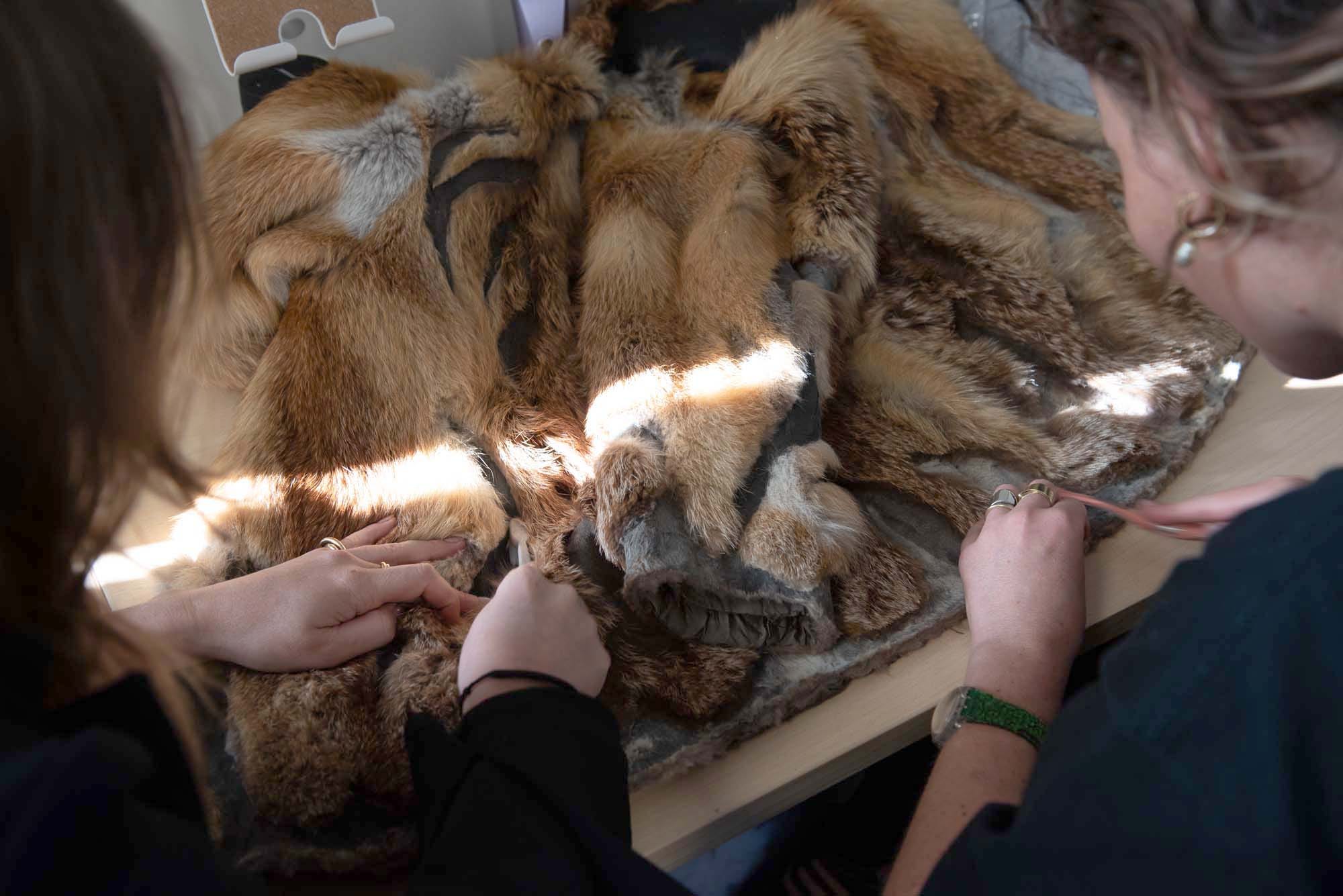
Tottenham HotFurs / Old Fur, New Flames
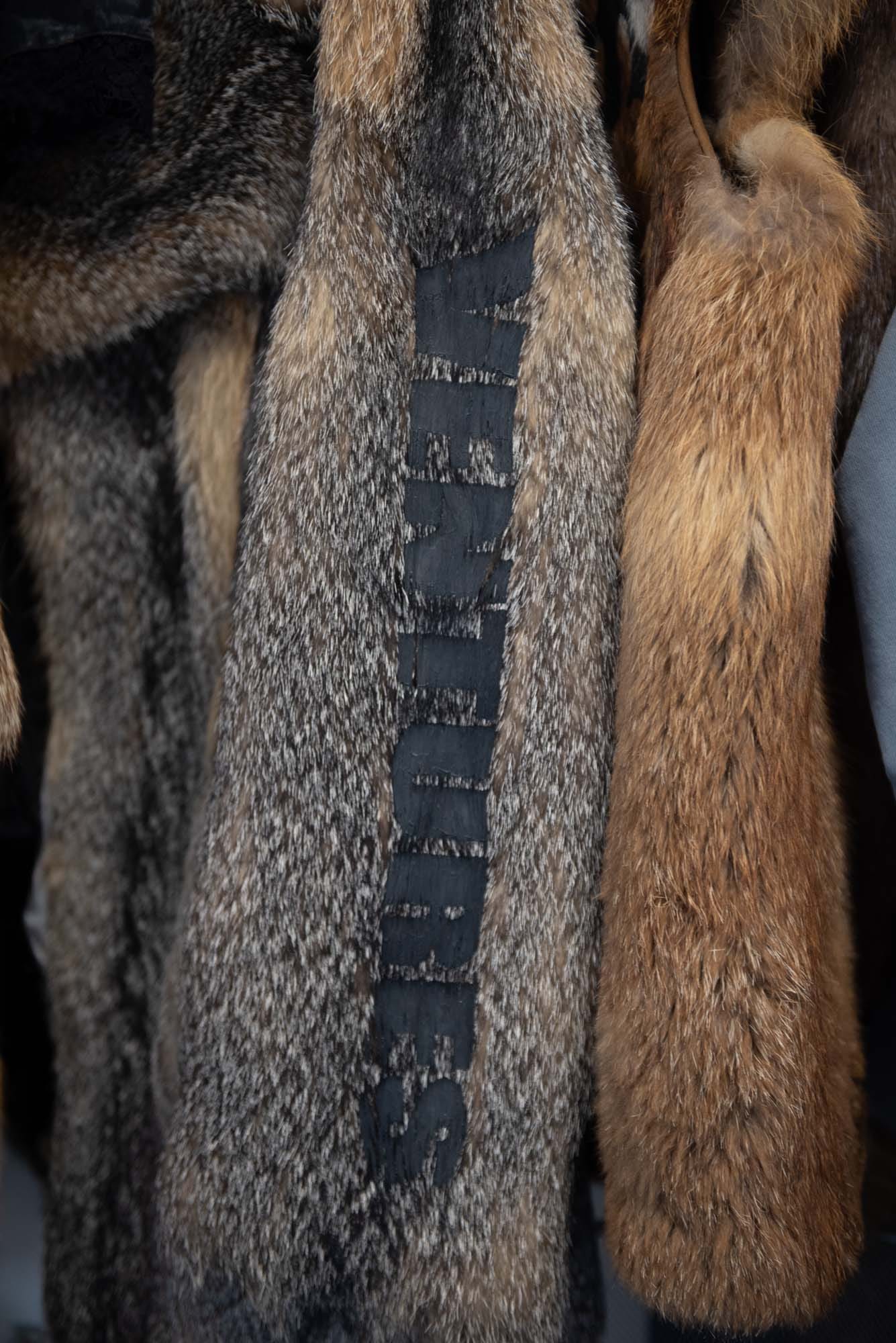
Over the past year, we sourced vintage coats across Belgium and the Netherlands. Some garments were intact, while others carried small to large defects. We also purchased fur accessories that many find too confronting, such as scarves with heads, tails, and paws; items typically discarded because nobody wants to reuse them. Through these choices, the project confronts the parts of fashion society prefers to ignore: waste, mortality, and the discomfort of material consequence.
We visited a furrier in Belgium to better understand the pieces. Together, we approximated the age and provenance of the coats through fur types, details, and branding, with several garments retaining their original labels, most of German origin. Some of the furs, like red fox, raccoon, and virginie fox, are less common today due to their thickness, as well as the additional wadding added for extra warmth, reflecting historical fashion choices and climate back then. Most coats are at least 40–50 years old, highlighting their longevity compared with modern faux fur, which often lasts only 5–10 years. Beyond durability, these coats carry emotional and cultural value: they were cherished, cared for, and passed down across generations, often as luxury items. Their continued presence reflects a history of careful use and preservation, emphasising both material and sentimental longevity that modern fashion rarely affords.
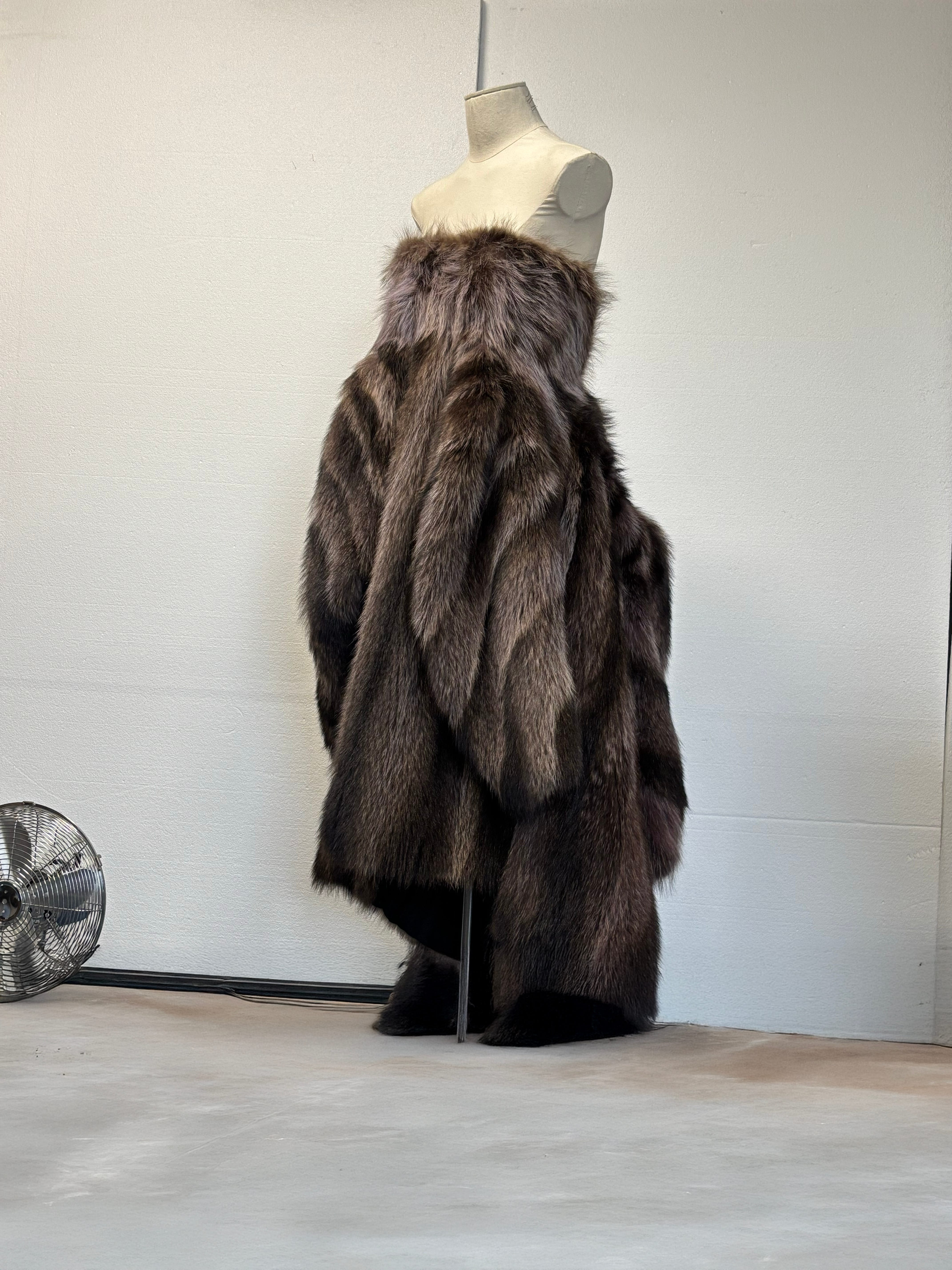
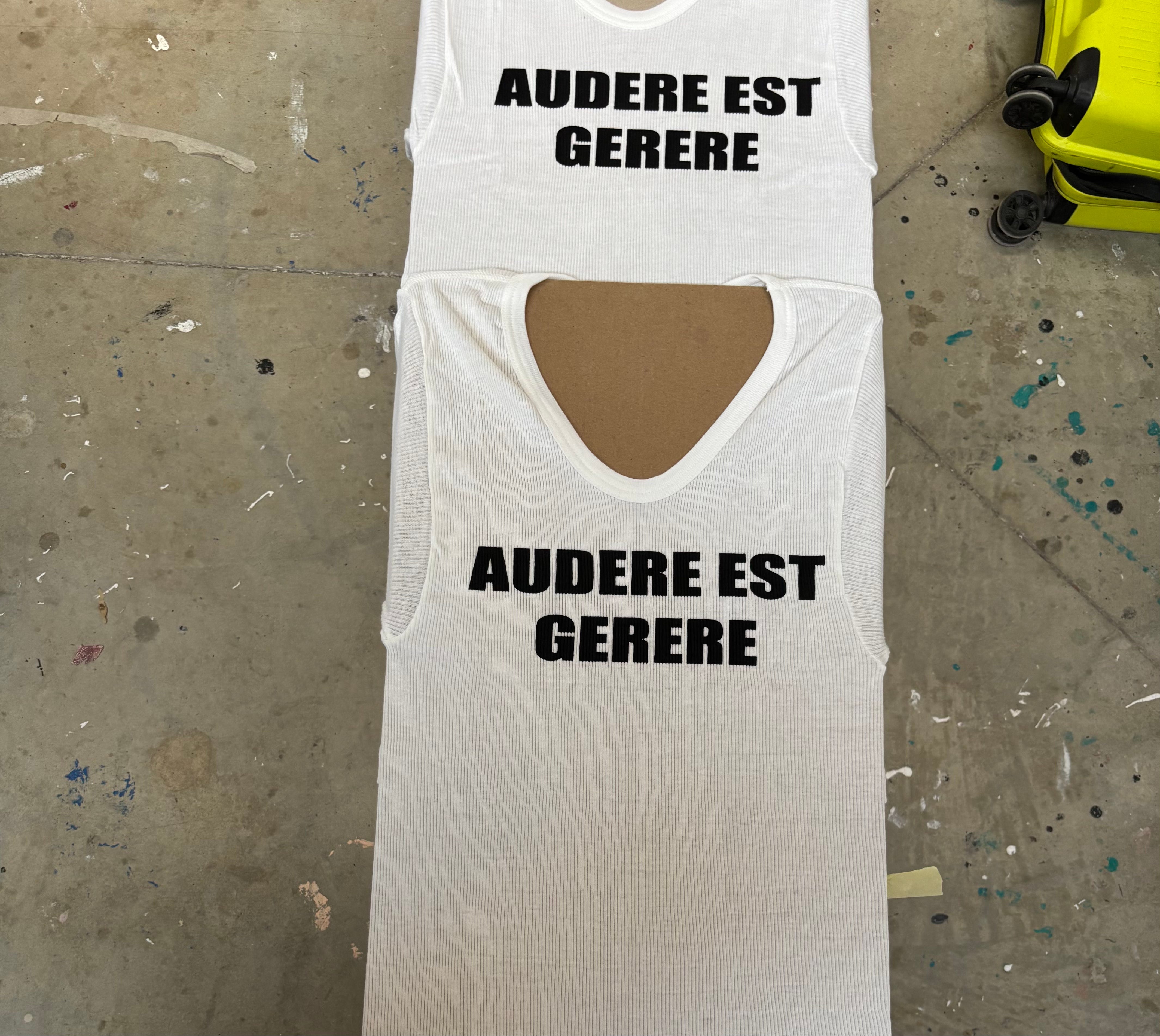
We personally transformed each coat through shaving, trimming, printing, and painting, making every piece unique. Our approach extends to every element of the coat: offcuts are repurposed into other garments or accessories, and even the shaved off fur is ground into flock for t-shirts.
The collection’s recurring flame motifs references both its name, HotFurs, and the urgency of the climate crisis. Fire symbolises transformation, reinvention, and the intensity of contradiction: a world on fire while we continue to buy clothes. The slogan, Audere est Gerere (“to dare is to wear,” to carry responsibility) draws inspiration from Tottenham Hotspur’s Audere est Facere. It signals the responsibility embedded in material choice and provokes reflection on the weight of ethical decision-making in fashion.
HotFurs merges high-brow and low-brow aesthetics: the bourgeois prestige of fur in the past, football culture, and popular culture converge to confront luxury, identity, and consumption. By upcycling materials others reject, it exposes the absurdity of discarding what is durable and valuable while simultaneously critiquing the marketing narratives that position new, synthetic alternatives as “ethical.”
The project ultimately interrogates the moral and cultural stakes of fashion. It challenges the ways brands frame sustainability while perpetuating systems of profit.
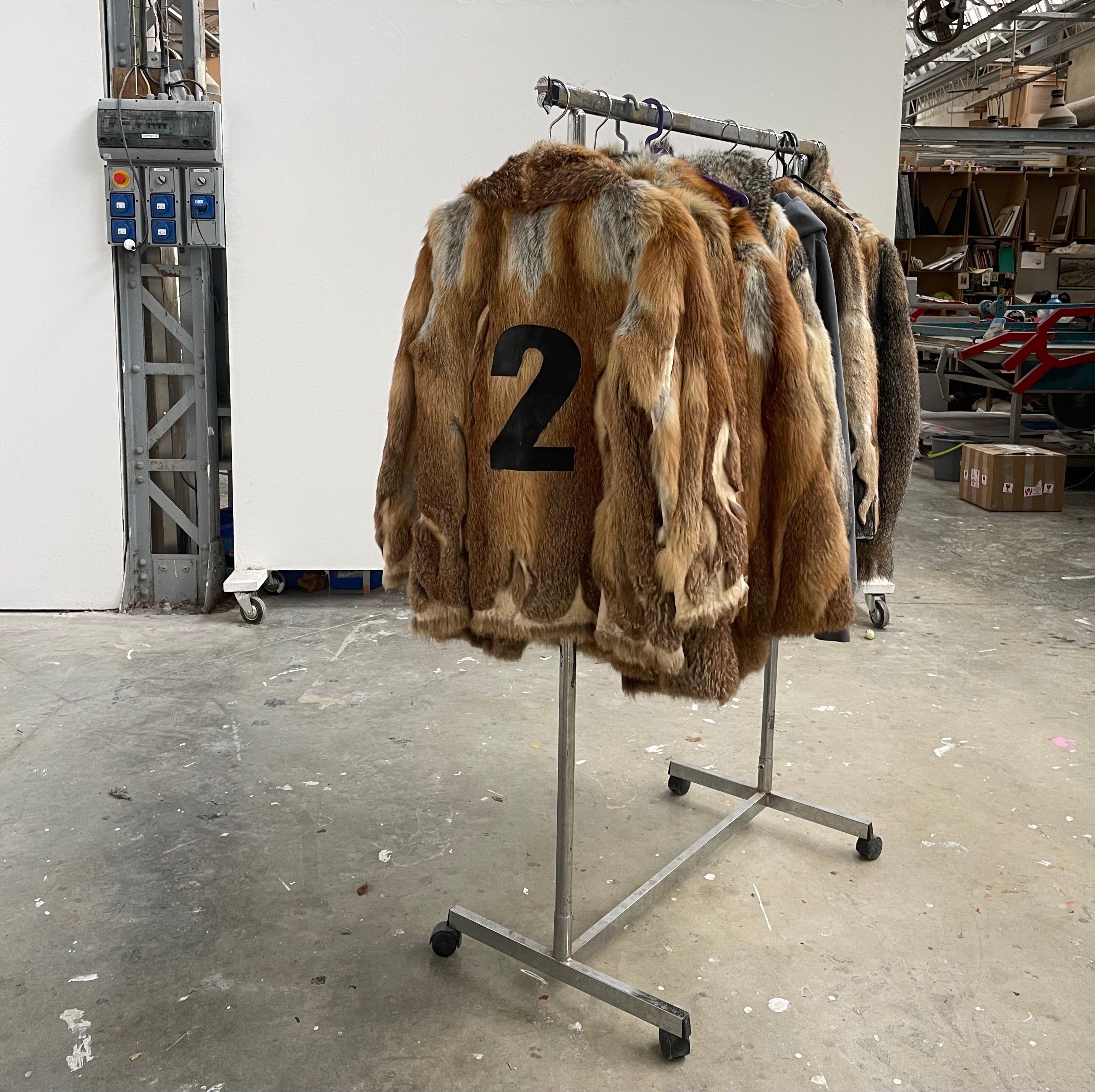
We don’t want to make new fur pieces, so each design exists only as a transformation of existing vintage. If you wish to purchase one of the designs, every piece is available in two ways; either you bring or send us your own vintage coat to be reworked, or we find one for you. In both cases, the outcome is singular, shaped by the unique material we encounter.
And yes - we can also print and transform fake fur, and we welcome other garments people wish to bring. Our aim is not purity, but to work with what is already there.
HotFurs suggests that fashion doesn’t need endless new production to exist. It can live through reinterpretation, memory, and critique, turning garments of the past into players of the present, carrying meaning beyond utility.
Parasite Ventures.
References & Further Reading (with special thanks to)
Books & Essays
Anti-Fashion Manifesto, Lidewij Edelkoort
No Logo, Naomi Klein (1999)
Fashionopolis: The Price of Fast Fashion and the Future of Clothes, Dana Thomas (2019)
The World Is On Fire But We’re Still Buying Shoes, Alec Leach (2022)
Status and Culture: How Our Desire for Social Rank Creates Taste, Identity, Art, Fashion, and Constant Change, W. David Marx (2022)
Reports & Research
Fossil Fashion: The Hidden Reliance of Fast Fashion on Fossil Fuels, Changing Markets Foundation (2021)
Preferred Fiber & Materials Market Report, Textile Exchange (2023)
Primary Microplastics in the Oceans, IUCN (2017)
The Future of Petrochemicals, International Energy Agency (2018)
Fashion Industry Charter for Climate Action Progress Report, UNFCCC (2022)
Articles & Journalism
“The Truth About Real Fur, Faux Fur, and Sustainability”, Amy Odell (Back Row, 2023)
“Fur Is Firmly Back in Fashion – And More Divisive Than Ever”, Ana Santi (BBC, 2025)
“Is Fur Still a Faux Pas?”, Bella Webb (Vogue Business, 2025)
“Is Wearing Vintage Fur Socially Acceptable Now?”, Emily Chan (British Vogue, 2025)
“The Vintage Fur Debate: Does It Honour the Animal or Normalise Cruelty?”, Lucianne Tonti (The Guardian, 2025)
“To Fur or Not to Fur? Three Fashion Writers Go Head-to-Head”, Dazed Digital (2025)
“What Ever Happened to Fashion’s Subcultures?”, Noah Johnson (i-D, 2023)
Other References
Shell is een prima bedrijf (Als ik de website mag geloven), Hang Youth (song, 2021)